Dallas heat is hard on a wrap that wasn't installed carefully. Edges that weren't sealed with heat, or film laid over dust and wax, tend to lift during the first hot summer, which is why the steps below matter as much as the film you choose.
The car wrap installation process at a glance
Every good wrap follows the same basic sequence, whatever the brand of film. The order matters because each step sets up the next one.
Here's what happens from drop-off to pickup.
| Stage | What happens | Why it matters |
|---|---|---|
| 1. Inspect and plan | Paint checked; panels, seams and film layout planned | Finds problems before film goes on |
| 2. Wash and decontaminate | Wash, clay bar, degrease and alcohol wipe | Adhesive needs bare, clean paint |
| 3. Remove trim and hardware | Handles, badges, lights or trim removed where practical | Lets film wrap edges for a cleaner, longer-lasting finish |
| 4. Install panel by panel | Film laid, positioned, squeegeed and trimmed | Controls stretch and avoids wrinkles |
| 5. Post-heat | Edges, recesses and stretched areas heated to set the film | Stops film pulling back and lifting |
| 6. Reassemble and inspect | Parts refitted; every edge checked | Catches bubbles or lifted edges before pickup |
| 7. Cure | Adhesive settles before washing or hard use | Helps the bond reach full strength |
Step 1: Inspection and planning
A careful installer looks at your paint before quoting the final job. Chips, dents, repainted panels and failing clear coat change how the car should be wrapped and how it will look.
Planning also decides where seams go on large panels, which parts come off, and how much film each panel needs.
Step 2: How to prepare a car for a wrap
Prep is the most important part of the job, and the step cheap installs skip. The car is washed, clayed to remove embedded contamination, degreased and wiped with alcohol so no wax or oil is left on the paint.
Bringing the car in reasonably clean helps, but don't apply wax, sealant or a spray detailer in the days before your appointment, since those can interfere with adhesion.
Step 3: Trim and hardware removal
Removing handles, badges, lights and some trim lets the film wrap around edges instead of being cut at them. That gives a cleaner look and fewer edges for heat and washing to attack.
Not every part should come off on every car. A good shop explains what they'll remove and why.
Step 4: Installing the film panel by panel
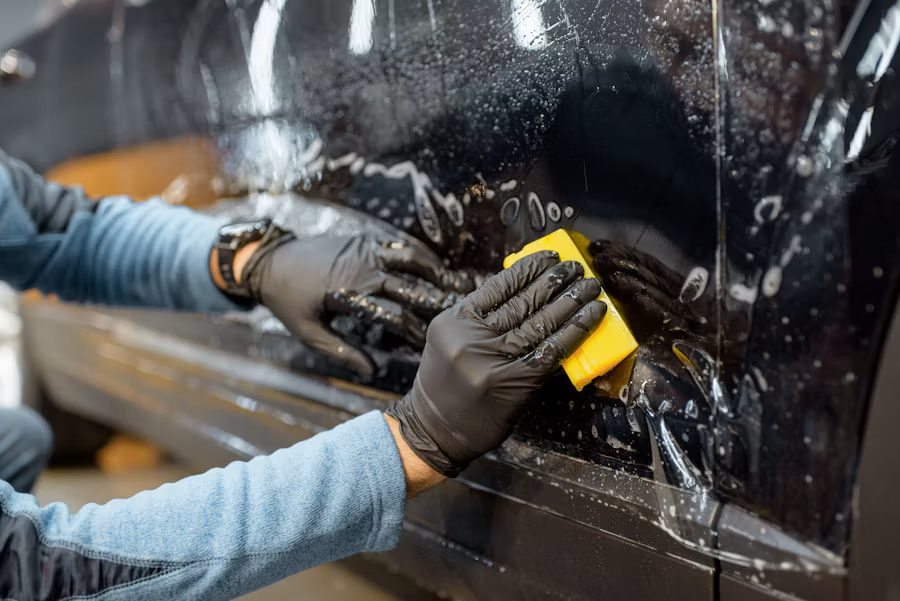
Film is applied one panel at a time, starting from the middle and working out. Installers use a squeegee to push out air and a heat gun to soften film into curves and recesses.
On complex areas they use small relief cuts or inlays so the film isn't overstretched. Overstretching thins the color and is a common cause of early failure.
Step 5: What is post-heating a wrap?
Post-heating means heating stretched areas and edges to a set temperature after installation. It relaxes the film's memory so it stays where it was placed instead of pulling back.
Installers typically post-heat every edge, recess and stretched curve, often checking temperature with an infrared thermometer. A wrap without proper post-heat may look fine on pickup day and lift weeks later in Texas sun.
Step 6: Reassembly and final inspection
Parts go back on and every panel is checked in good light. The installer looks for lifted edges, bubbles, wrinkles, color mismatch between panels and any exposed old color.
This is the moment to walk around the car with the installer and ask questions.
How long does it take to wrap a car?
A full wrap usually takes a few days, including prep and settling time. Partial wraps, chrome delete and roof wraps are typically quicker.
Complex vehicles, door jambs and specialty films take longer. A shop that promises a full wrap in a few hours is usually skipping prep or post-heat.
Can I drive my car right after it's wrapped?
Yes, you can usually drive it home, but treat it gently for the first several days. The adhesive keeps building strength after installation.
Avoid washing for the first few days, skip pressure washers and brush car washes, and follow your installer's specific instructions. Then see how to make a wrap last in Texas heat.
- Wait several days before the first wash, or as your installer advises
- Hand wash only; no brush car washes
- Keep pressure washers away from edges
- Park in shade when you can during the first week
- Report any lifting edge early so it can be fixed
Book a wrap with a clear process
Ask any shop to walk you through these steps before you book. You can request a free quote or call (469) 971-2565. Learn more on our color change wrap page, or see what to check in choosing a car wrap shop. We serve Dallas, Carrollton, Addison and nearby cities.
The bottom line
A proper car wrap installation process covers inspection, deep prep, careful panel-by-panel install, post-heating and curing. Pro Car Wraps Dallas serves Dallas, Plano, Frisco, Richardson, Addison, Carrollton, Allen, McKinney, Garland and Southlake. Request a free quote or call (469) 971-2565.